Vinyl Hour!
Nebraska - Columbia Records, 1982

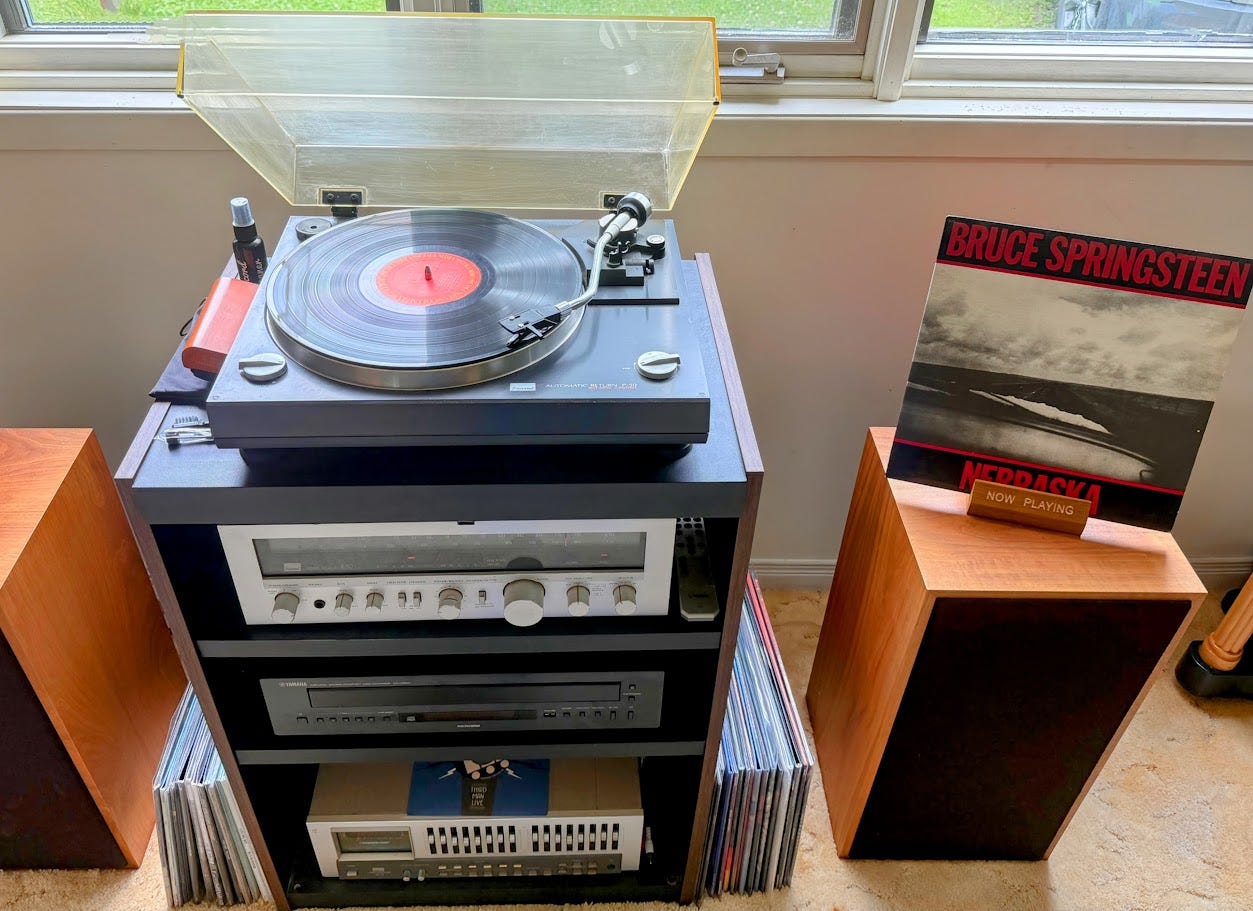
"Lord, won't you tell us
Tell us, what does it mean?
At the end of every hard-earned day
People find some reason to believe"
—from Reason to Believe, lyrics by Bruce Springsteen
Nebraska is Bruce Springsteen’s raw, haunting masterpiece—filled with desperate characters, dark stories, and starkly beautiful melodies. To preserve the intimacy and eerie emotional power of the songs, he released the original demo cassette recordings largely as-is, as a solo album.
Bruce recorded the songs alone on a TEAC four-track cassette recorder in his New Jersey bedroom. Though he initially planned to re-record them with the E Street Band, the stripped-down demos carried a ghostly emotional power that couldn’t be recreated.
Made between The River and Born in the U.S.A., Nebraska remains one of the strangest left turns in mainstream rock. At the very moment Bruce could have doubled down on arena-rock success, he released a bleak, intimate acoustic album filled with killers, drifters, lonely figures, and spiritual exhaustion. Remarkably, some songs from Born in the U.S.A. emerged from the same creative burst—with the same songwriter simultaneously producing fist-pumping anthems and the haunted world of Nebraska.
That tension between commercial triumph and emotional desolation gives Nebraska its enduring power. Bruce abandoned the arena-sized hooks and focused almost entirely on storytelling, writing with the eye of a novelist and the compassion of someone deeply attuned to outsiders, lost souls, and moral ambiguity. The songs unfold like stark American short stories, drawing from newspaper crime accounts, the film Badlands, Flannery O’Connor-style Southern Gothic darkness, and lonely rural landscapes.
These tracks have always felt personal to me. As a kid, living with my father in small apartments, I’d walk through quiet middle-class suburban neighbourhoods, staring at the houses and imagining what it would one day be like to live in one, a feeling of distance and longing that Mansion on a Hill captures perfectly.
My father also drove a used car, and I remember feeling embarrassed by it at the time, even telling myself that when I moved out I’d never own one. Looking back, that embarrassment was misplaced—it was a blue 1970 Chevy Malibu, a very cool car.
Reason to Believe struck me in a different way. I’ve always been a relentless optimist with strong perseverance, and I heard the song less as despair than as endurance—carrying on through disappointment, loss, and the grind of everyday life. In fact, I didn’t fully realize until much later that many people hear it as quite a bleak song; my focus was always drawn to the message of hope beyond the despondent circumstances.
And then there’s Open All Night, one of my favourite songs ever, a Chuck Berry-like burst of rock and roll propulsion, all jittery guitar and forward motion, delivered in a near-rap of words that race at you like highway signage at speed. On first listen, the lyrics seemed almost impossible to remember, but somehow they soon began to flow off my tongue. One day driving together with the song on, I told my wife that the day I can no longer remember its lyrics is the day Alzheimer’s has set in.
Two years ago, I went on a dream road trip through the United States and Canada with a close friend. We listened to the album while driving through Nebraska, and it became one of my most unforgettable listening experiences. Hearing Atlantic City in that landscape gave it a strange, aching resonance—especially the line: “Everything dies baby that’s a fact / but maybe everything that dies someday comes back.”
Nebraska was initially shocking because it sounded nothing like the Bruce Springsteen people expected in 1982. Critics quickly recognized it as a daring artistic statement, and its reputation has only grown. It’s now widely regarded as one of the greatest singer-songwriter albums ever made, and a landmark in lo-fi home recording—a record that turned stark simplicity into lasting emotional power.
Do you remember the first time an album completely changed the way you heard music?
If this sparked a memory or brought a smile, subscribe and join me Monday–Friday as I rediscover the vinyl that shaped my life.
The record that really changed all my listening habits was Feats Don’t Fail Me Now
Superb choice!!