Vinyl Hour!
Rust Never Sleeps - Reprise Records, 1979

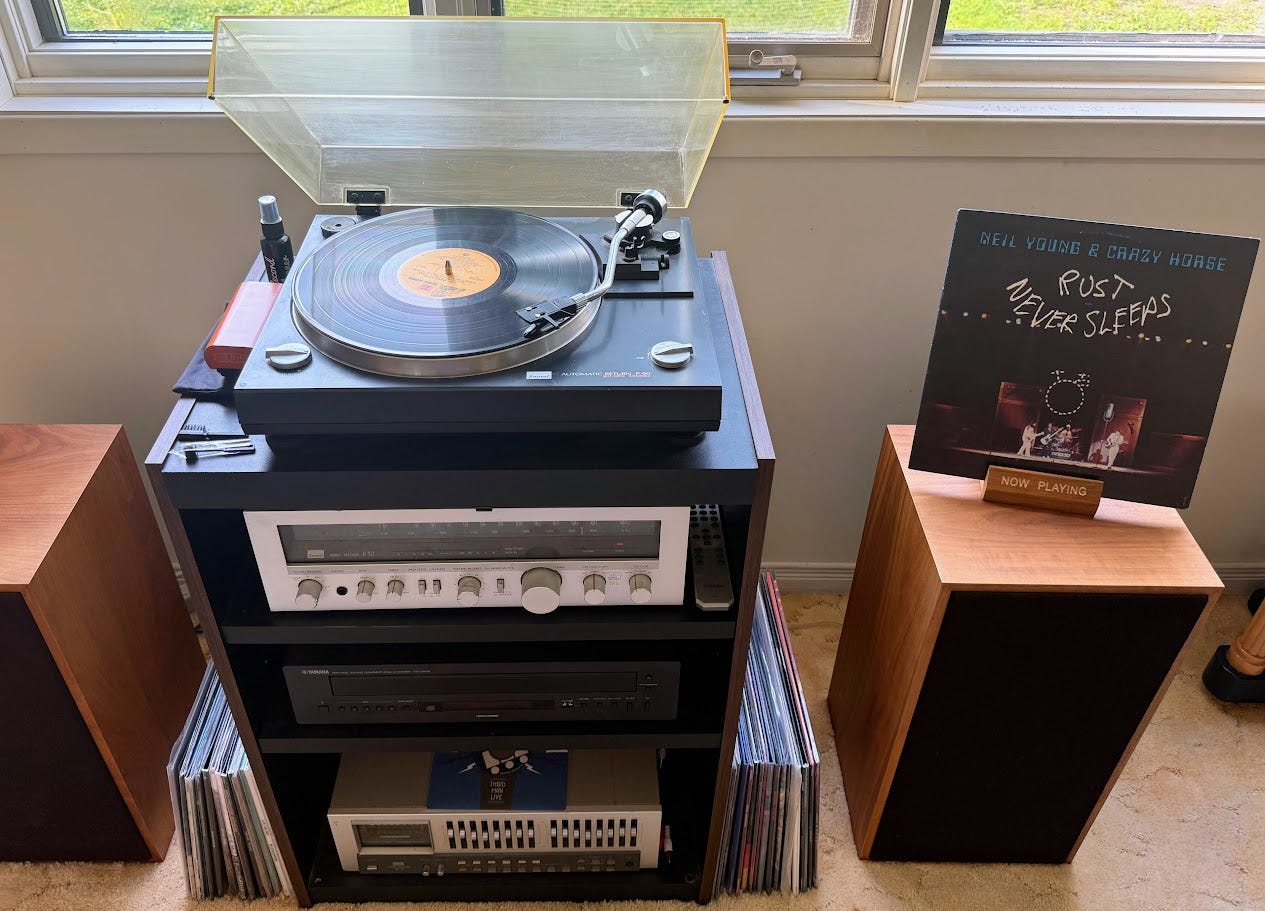
"Look out, Mama, there's a white boat coming up the river
With a big red beacon and a flag and a man on the rail
I think you'd better call John
'Cause it don't look like they're here to deliver the mail
And it's less than a mile away
I hope they didn't come to stay
It's got numbers on the side and a gun
And it's makin' big waves"
—from Powderfinger, lyrics by Neil Young
Rust Never Sleeps, Neil Young’s late-’70s masterpiece, is half acoustic ghost story and half electric apocalypse. Its structure feels almost cinematic: Side One is intimate, fragile, and haunted, while Side Two erupts into distorted Crazy Horse fury. Much of the album was recorded live, then heavily overdubbed and refined in the studio, with crowd noise reduced or removed to give it a more controlled, studio-like feel. The result is a thrilling hybrid—as raw and volatile as a concert, yet as focused and immersive as a studio record.
The album’s influence on grunge is enormous. The electric side especially—Sedan Delivery, Welfare Mothers, and Hey Hey, My My—helped pioneer distorted guitar sludge, emotional rawness over technical polish, heavy repetition, and a damaged, vulnerable intensity. That combination became central to grunge, and bands like Nirvana, Pearl Jam, and Soundgarden all acknowledged Young’s influence. His use of drop-D tunings and massive, corrosive guitar textures also helped shape the sonic palette of grunge guitarists.
Kurt Cobain quoted the lyric “It’s better to burn out than to fade away” from My My, Hey Hey (Out of the Blue) in his suicide note. Originally, the line reflected Neil Young’s belief in artistic vitality and resistance to complacency—the idea that creative energy must remain alive or “rust” takes over. It was never intended as a romantic statement about dying young, but after Cobain’s death the lyric inevitably took on a far darker cultural resonance.
Beyond its cultural impact and legacy, Rust Never Sleeps endures because the songs themselves are extraordinary—among the most powerful, emotionally resonant, and musically dynamic of Neil Young’s career. Powderfinger remains one of my all-time favourite songs, a perfect cinematic tragedy about fear, violence, and fate, driven by a crushing Crazy Horse riff, a searing guitar solo, and one of Young’s greatest narrative performances.
That momentum carries through the electric side of the album where the intensity never really lets up. Welfare Mothers stands out in particular as one of the most abrasive and confrontational tracks, all jagged rhythm and chaotic energy, pushing the band’s rawest instincts to the surface. It captures the snarling, unpolished edge of Crazy Horse at full voltage, helping define the album’s harsher electric terrain.
In contrast, Thrasher is the album’s quiet centre of gravity. Built on a gentle acoustic flow, it unfolds like a long reflective meditation on friendship, time, and the cost of change. Where the electric side burns with distortion and friction, Thrasher feels spacious and searching, carrying a sense of farewell without drama, just quiet acceptance and emotional clarity.
Rust Never Sleeps reaffirmed Neil Young’s relevance and helped earn him the title “Godfather of Grunge.” It stands as one of his greatest albums, often placed in his top five and, for some, at number one. It bridges classic rock and alternative rock, serves as a key proto-grunge landmark, and remains a powerful statement about artistic survival. A true classic.
If rust never sleeps, what does it mean for an artist to keep evolving rather than settling into comfort?
If this sparked a memory or brought a smile, subscribe and join me Monday–Friday as I rediscover the vinyl that shaped my life.
You can also read my essays on the Neil Young albums Everybody Knows This is Nowhere and Reactor
Such an influential record. I’m sure you know it, but Cowboy Junkies cover of Powderfinger is unbelievable.
"Powderfinger" and "Thrasher" hit the sweet spot of having lyrics that were evocative and compelling but not overly literal, leaving some space for enjoyable ambiguity and interpretation.
"Brings back the time when I was 8 or 9, I was watchin' my mama's tv, it was that great Grand Canyon rescue episode." I don't know exactly what you're going for there, Neil, but I'm 100% on board.
The musicianship on "Powderfinger" is just completely badass.