Vinyl Hour!
Rei Momo by David Byrne — Sire Records and Luaka Bop, 1989

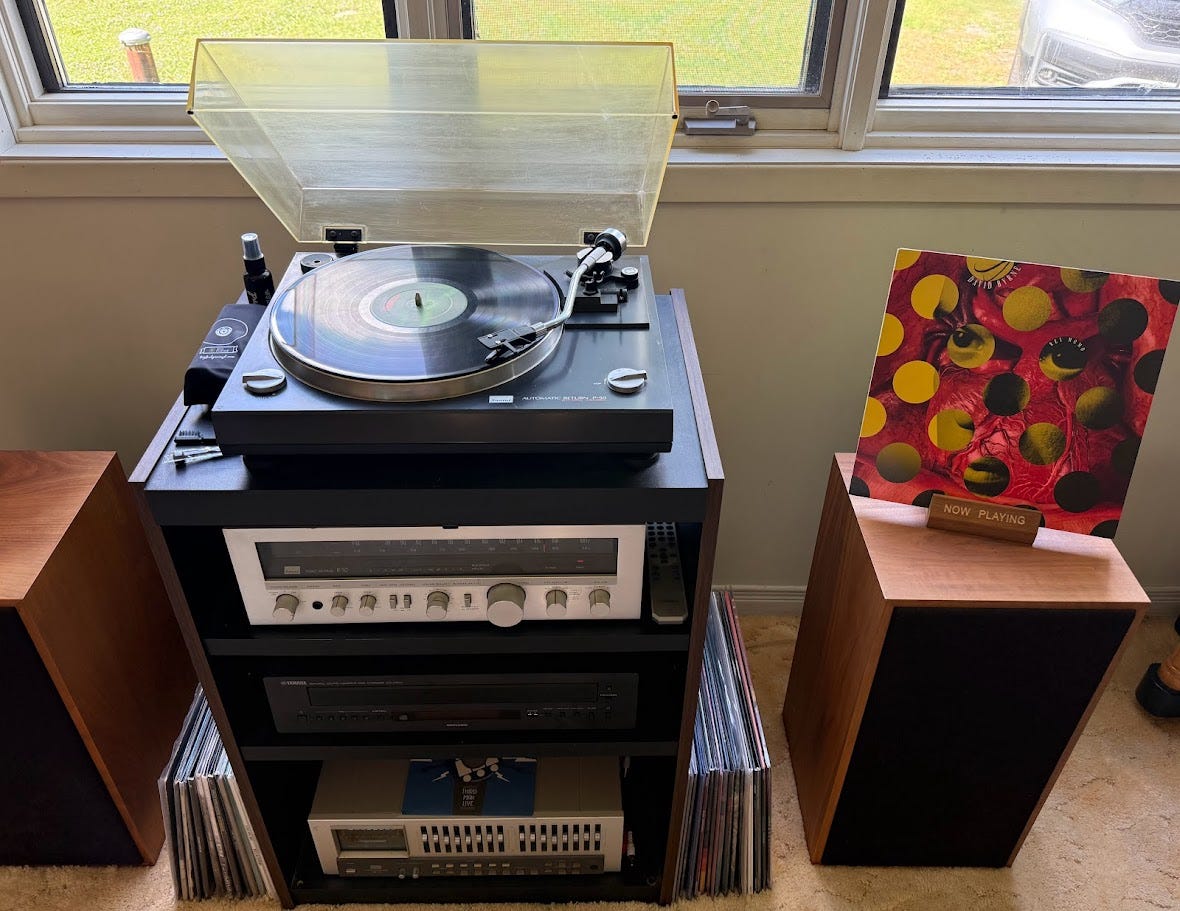
"Marching through the wilderness
Crying out for tenderness
They call me Mr. Pitiful
But everything is wonderful"
—from Marching Through the Wilderness, lyrics by David Byrne
Rei Momo was David Byrne's first true solo album after Talking Heads. While he had released soundtrack and collaborative projects earlier, this was his first major artistic statement on his own and a clear break from the sound that made him famous. Rather than repeat a successful formula, Byrne built the album around Latin American rhythms, with each song drawing from styles such as mambo, merengue, samba, and cumbia. Working with acclaimed Latin musicians including Celia Cruz and Willie Colón, he created one of the most adventurous and distinctive albums of his career.
Receiving fair to middling reviews upon release, it is now seen as one of the early and most visible examples of world music fusion in mainstream pop—in this case, Latin rhythms and pop music. Byrne wasn’t merely borrowing exotic sounds. He studied the traditions seriously and later expanded that interest through his Luaka Bop label, helping introduce international music to North American audiences.
The album has grown on me over the years. I love Byrne’s quirky, abstract, and philosophical lyrics. He’s one of popular music’s great observers, exploring identity and role-playing, the strangeness of everyday life, urban existence, social rituals, and the gap between reality and imagination. He often sounds like an anthropologist studying human behaviour, yet beneath the irony there’s warmth, empathy, and genuine affection for his subjects.
On Rei Momo, Byrne combines his classic themes of identity, imagination, and human behaviour with an infectious mix of Latin rhythms, creating music that is as intellectually engaging as it is danceable. There’s Make Believe Mambo, perhaps the album’s masterpiece. Driven by bright horns and an irresistible mambo groove, it’s joyous on the surface, but underneath it’s about identity, performance, television culture, and people constructing themselves from media images.
Independence Day is a brilliant opening track, propelled by vibrant percussion and a festive carnival atmosphere. Mixing romance, sexuality, freedom, and city life, it immediately announces that Byrne’s Latin experiment is going to be playful rather than academic.
I also love The Dream Police and Carnival Eyes, the first a philosophical meditation disguised as a merengue-driven pulse, its bright, propulsive rhythm contrasting beautifully with lyrics about instinct, ambition, and humanity’s connection to nature. Carnival Eyes slows things down, built on a softer, swaying rhythm and warm, hazy instrumentation, as Byrne reflects on perception, desire, and the thin boundary between reality and imagination.
What stays with me is the physicality of it—the way the percussion carries everything forward, turning ideas into movement. It works as much through the body as the mind, shifting between joy, reflection, and curiosity. Rei Momo can feel loose and celebratory, but there’s real depth beneath it: a sense of Byrne testing how far rhythm and thought can merge. Over time, it’s come to feel like a fully realised world—playful, intelligent, and alive with colour and imagination.
In the end, does Rei Momo feel more like an experiment—or a fully formed world?
If this sparked a memory or brought a smile, subscribe and join me Monday–Friday as I rediscover the vinyl that shaped my life.